









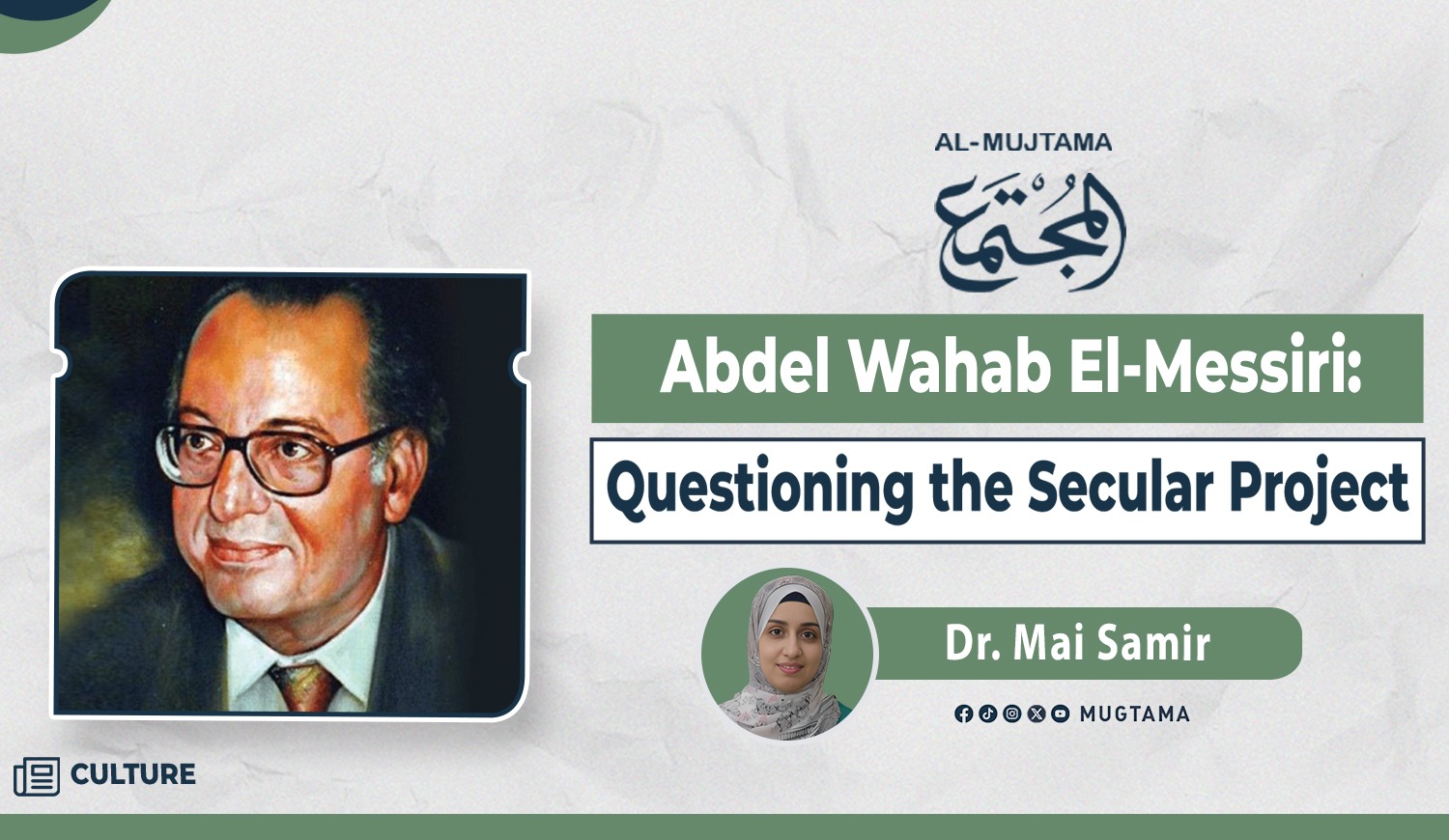
Abdel Wahab El-Messiri: Questioning the Secular Project
Various
intellectual approaches have emerged in the Arab and Islamic world to critique secularism, given the perceived
threat it poses to civilizational revival. Many thinkers argue that genuine
renaissance cannot be achieved apart from the Islamic religious and cultural
foundation. In this view, secularism understood as a set of ideas, beliefs, and
measures aimed at neutralizing religion, isolating it from political and social
life, and confining it to a narrow personal sphere is regarded as a Western
conspiracy against Islam. Its ultimate goal, they contend, is to strip Islam of
its essence as a comprehensive faith and divine legislation designed to
regulate both private and public aspects of life.
The
late Egyptian thinker Dr. Abdel Wahab El-Messiri distinguished himself in his
critique of secularism by offering a deeper and more comprehensive vision. He
did not treat secularism merely as a partial concept, but as an epistemological
and civilizational paradigm embedded in all aspects of Western life and
governing its various domains. His critical project sought to refine and
challenge the concept within a broader understanding of Western civilization
and its ruling ideology. Ultimately, this enabled him to dismantle claims that
attempt to reduce secularism to the narrow definition of “separating religion
from the state” or confining it to a set of simple procedures and practices.
Abdel Wahab El-Messiri’s critique of
secularism studies.
Within his study of secularism,
Abdelwahab El- Messiri directed significant criticism at Arab
scholarly works that attempted to examine and critique secularism. He argued
that many of these projects fell prey to a series of methodological,
substantive, and theoretical errors. According to El-Messiri, such shortcomings
weakened the intellectual engagement with secularism and limited the depth of
analysis. His main criticisms of Arab approaches to secularism can be
summarized as follows:
The Problem of
Reductionism and Oversimplification: Many
Arab studies confined secularism to the narrow definition of “separating
religion from the state.” This excessive simplification failed to capture the
structural and comprehensive dimensions of the concept, preventing scholars
from grasping its full flaws and destructive repercussions across both public
and private life.
The Problem of Fixity: These studies treated secularism as a static idea
rather than a historical process unfolding in successive stages. As a result,
scholars examined only the reality of their own moment in time, without tracing
the sequential developments of secularism in societies where it was applied.
The Problem of Definition: Given the diversity of secular practices in the West
and the absence of a unified model, definitions and terminologies varied
widely, each describing different aspects of the same phenomenon. Moreover,
Arab studies overlooked the extensive Western revisions of the concept within
broader critiques of modernity. This left them unaware of the evolving
dimensions of secularism and the debates surrounding it in Western thought.
Secularism in El-Messiri’s Intellectual
Project
Building on his critique of Arab
studies on secularism, Abdel Wahab El-Messiri developed his project around a
key distinction between “partial” and “comprehensive” secularism. In his view,
partial secularism is superficial, simple, and inevitable, confined mainly to
the political—and perhaps economic—sphere. It is acceptable, he argued, since
modern states, with their complex structures, procedures, and bureaucracies,
necessarily require a separation between religious institutions and the state.
Religious authority cannot merge with political authority in any sophisticated
civilizational framework. Islam itself, El-Messiri noted, acknowledges this
principle in the Prophet’s saying: “You are more knowledgeable about your
worldly affairs.” Thus, partial secularism does not, in his perspective,
conflict with Islam.
At the same time, El-Messiri stressed
that partial secularism often promoted as synonymous with secularism is not
inherently dangerous, as long as it does not apply to the ultimate values and
governing references of society and the state. However, secularism, in his
view, extends far beyond this partial scope. It surpasses the realms of
politics, economics, and ideology, evolving into sweeping social secularization
that undermines private life. Through the mechanisms of the Western secular
state, as well as educational, entertainment, and media institutions, secularism
penetrated the human psyche, shaped behavior, and family relations, and eroded
what remained of Christian or even basic human ethics.
Thus, secularism initially marketed as
the mere “separation of religion from the state” shifted from a partial to a
comprehensive paradigm. Alongside this shift, the West moved from a phase of
rigidity to one of fluidity, through a historical sequence in which secularism
evolved from partial stages into a comprehensive stage. For El-Messiri,
comprehensive secularism represents a worldview with an ultimate
epistemological dimension. It seeks to dismantle the relationship between
religion, moral absolutes, and metaphysical principles across all spheres of
public life, replacing them with materialism. This materialist outlook regards
the universe as self-contained, without transcendence, purpose, or ultimate
goal. It denies uniqueness, permanence, or absolutes, and rejects religious
promises concerning the afterlife, reward, and punishment.
According to El-Messiri, the realization
of partial secularism in any society at any historical moment and regardless of
whether it begins in the economy, politics, society, or private life inevitably
sets in motion a sequence that expands into all domains. This progression
ultimately leads to comprehensive secularism. El-Messiri attributed this
outcome to the dominance of Western civilization, from which secularism
originally emerged, and to the latent materialist inclination embedded in human
nature itself.
Secularization and Everyday Life
El-Messiri’s interpretive model of
partial and comprehensive secularism offers crucial insights into the daily
practices and routines we live by. While these practices appear ordinary, he
argued, they in fact deepen the impact of secularization on our societies and
inner selves, marginalizing values, absolutes, faith, and spirituality in favor
of conflict-driven norms, materialist ethics, and a “law of the jungle”
mentality.
At the forefront of such practices,
El-Messiri pointed to high levels of consumerism pursuing fashion trends,
consuming fast food devoid of nutritional or cultural value, and adopting
globalized behaviors under the guise of renewal. These patterns, he contended,
produce a functional, materialist human being who neither seeks transcendence nor
perceives meaning beyond appearances. Instead, the individual becomes a
distorted replica of the “global citizen”: wearing the same fashion, eating at
the same international chains, engaging in social media challenges and trends,
and chasing money to fuel endless consumer desires trapped in a cycle stripped
of values, ethics, and fully secularized.
Finally, El-Messiri’s project sought
to establish a clear distinction between thought and ideas. He
argued that the Arab intellectual tradition has often focused on transferring
isolated ideas rather than engaging with thought as an integrated system. True
thought, in his view, requires a comprehensive framework in which ideas are
unified by a single paradigm. When dealing with Western concepts particularly
secularism Arab scholars tended to adopt individual ideas without recognizing
the underlying model and its potential dangers and implications. This neglect
of the epistemological dimensions of Western concepts weakened critical
perspectives and led to the accumulation of contradictory ideas side by side
without proper differentiation. El-Messiri therefore called for a
reconsideration of Western ideas as unified systems rooted in overarching
intellectual paradigms, urging a reevaluation based on this holistic vision.
You may also like:
Crisis of Modern Secularism: Why Societies Need a Moral Religious Law?
The Term ‘Secularism’ Between Theory and Practice- Europe as a Model (1–3)
The Term “Secularism” Between Theory and Practice: Europe as a Model (2–3)
How Islam Shapes Civilized Humans ?
