









A Digital Auction… Morality for Sale!

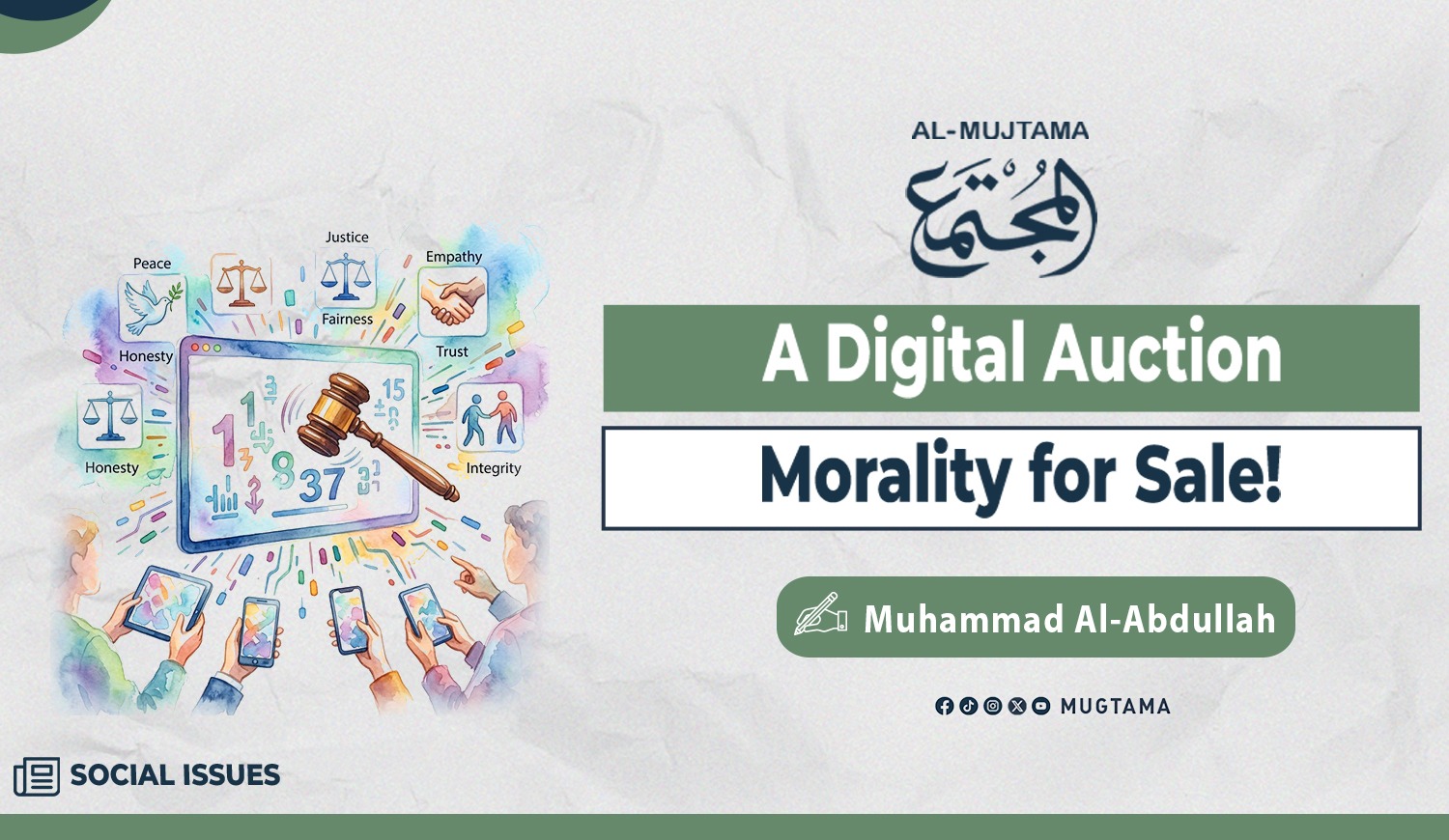
In a time when everything is measured by
likes and views, honesty has become a rare commodity, and pure intention an
unused currency. From misleading advertisements to polished content, from
interest-based relationships to forged academic credentials, values are
retreating in a market where there is room only for whoever sells at the
highest price.
The Edelman Trust Barometer report
for 2024 indicated that 64% of people worldwide do not trust commercial
advertisements, and that more than 70% doubt the credibility of digital
influencers when they talk about products. The main reason behind this lack of
trust in advertisements and influencers is their political affiliations and the
impact these affiliations have on their messaging.
Even in professional environments, a survey
by PwC in the Gulf revealed that 46% of employees believe that career
advancement depends on connections rather than competence.
Thus, the moral landscape seems like an
open auction where some sell their consciences in the name of success, while
the values that once guided society are pushed aside.
Deceiving Consumers
The nature of “transaction” has changed in the age of digital platforms and social media; intentions are no longer hidden but
displayed in front of the camera, in live broadcasts, and advertising is no
longer about promoting a product but showcasing the self.
In Saudi Arabia, for example, the General
Commission for Audiovisual Media warned in an official statement in September
2024 against influencers promoting unlicensed or misleading products after
complaints about consumer deception increased.
The same scene was repeated in Kuwait and
the UAE with the issuance of laws regulating electronic advertisements and
requiring influencers to obtain prior permits.
But the deeper question is: Can the law
alone recalibrate the moral compass, considering that what is happening is not
merely promotional violations, but a cultural shift that turns self-interest
into a measure of honesty, and profit into a goal that justifies the method?
The Transformation of Concepts
The danger lies in the moral concepts themselves being reshaped. Lying has
become “marketing intelligence,” flattery has become “a communication skill,”
abandoning principles is labeled “flexibility,” and earning money—regardless of
its source—is “cleverness and savvy”!
According to a study conducted by Qatar
University in 2023, nearly 58% of Gulf youth believe that success in the
workplace requires “value adaptation,” which for many means compromising
certain principles to achieve personal benefit.
It is therefore a crisis of awareness
before it is a crisis of behavior; when ethical language is distorted,
wrongdoing becomes acceptable as long as it is profitable, and the question
about the true moral value of an action disappears. This is summed up in a
phrase worth citing here: “Evil
does not prevail because it multiplies, but because it is redefined as good.”
In the past, values were instilled at home,
in school, and in the mosque—passed down by fathers, relatives, and neighbors.
Today, the new generation learns “fame” before it learns “honesty.
Gulf educational studies show that children
under the age of 15 are exposed daily to more than 200 digital messages
promoting consumerist or appearance-based values, while content that reinforces
honesty and trustworthiness is largely absent.
In a survey conducted by the “UAE Identity
Authority,” 78% of parents expressed concern over changes in their children’s
behavior due to targeted commercial content. Thus, a generation is being formed
that knows how to market, but does not know why it must be truthful.
The Path to Restoration
Restoring values is not a moral sermon—it is a comprehensive social awareness
project that begins with schools that teach applied ethics, not just
theoretical texts; with media that honors the truthful, not the most followed;
and with legislation that punishes deception rather than overlooks it under the
claim of economic freedom.
Religious discourse is also required to
redefine trustworthiness in a complex digital reality and remind people that
honesty is not a luxury but a condition for human continuity. Allah says: “So whoever does an atom’s weight of good will see it.” (Az-Zalzalah 99:7)
This principle makes trustworthiness a value that
cannot be negotiated or traded, for a society that loses its honesty loses its
respect for itself. There can be no real construction without ethics, and no
economic prosperity can endure in an environment that knows no integrity.
Today, values need those who purchase them
with awareness, not money—those who pay the price of honesty with
steadfastness, not fleeting gain. Honesty is not sold in markets, yet it is the
only thing capable of establishing a just marketplace.
And when values return to their proper
place, we will no longer need many laws, but rather consciences that know that
benefit is not measured by what we gain, but by what we preserve of our
humanity.
-------------------------------------------------------------
Read Also:
-
Raising Generations Between Religious Heritage and Digital Age Requirements
