









Book Review
“Disordered Minds: How Dangerous Personalities Destroy Democracy” by Ian Hughes
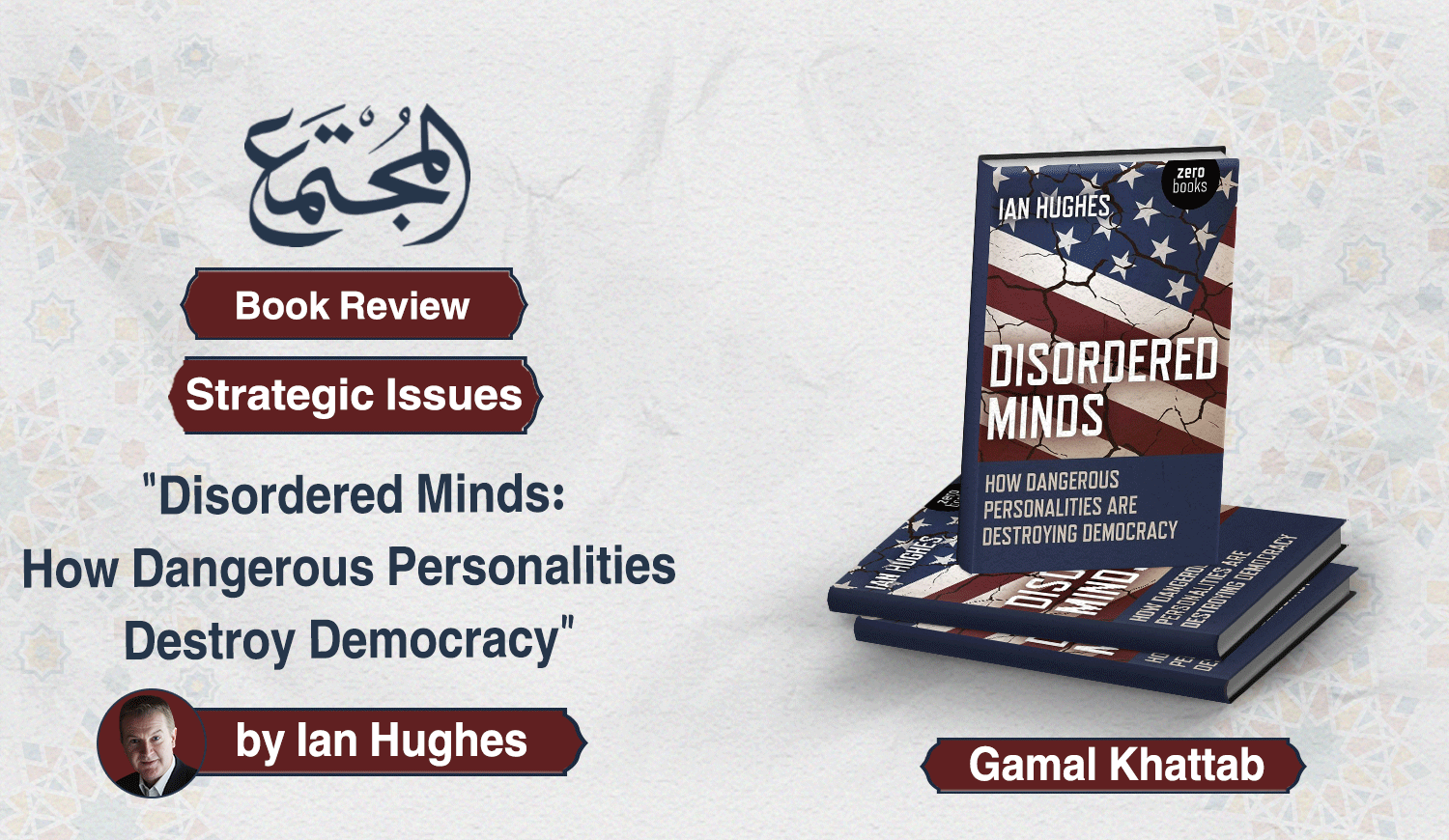
The dilemma of the rise of authoritarian regimes and the erosion of democratic systems is one of the most urgent and profound issues in contemporary political thought. Classical and Marxist political theories have focused on structural factors—such as economic crises, class struggle, and institutional failure—as primary causes of political collapse, while a growing current is now restoring attention to the psychological element in explaining political phenomena.
Irish analyst and academic Ian Hughes’s book Disordered Minds belongs to this psychological
current, advancing a bold central thesis that "democracy is threatened not
only by market mechanisms or institutional corruption, but existentially by a
pathological social-psychological structure in which a small percentage of human beings suffering from severe personality disorders succeed greatly in
climbing to the top of the power hierarchy."
In his vision, Hughes draws on a solid
interdisciplinary intersection uniting political science, developmental psychology, and modern neuropsychology to reframe "political evil"
not as a mere moral choice, but as a pathological clinical phenomenon reflected
in social structures.
The Central Thesis: The "Dark Triad" as a Wrecking Ball for Democracy
Hughes divides his thesis through a
categorical dissection of three major personality disorders he sees as the
primary driver of major historical and political tragedies—what is known in
psychology as the "Dark Triad":
1. Psychopathy: Characterized by the total and complete absence of
emotional drives, lack of remorse, inability to empathize with others’ pain,
and a superior capacity to manipulate masses.
2. Malignant Narcissism: Going
beyond ordinary narcissism to a colossal inflation of the self, an urgent need
for absolute control, excessive hostility toward any criticism, and regarding
the self as above laws and norms.
3. Paranoia: A
sustained state of irrational suspicion, a permanent sense of conspiracy, and
dividing the world into a sharp binary of "absolute friends" or
"enemies that must be exterminated."
Hughes affirms that these
individuals—who represent a small statistical percentage in any society
(ranging between 1% and 5%)—suffer from structural damage to their capacities
for social integration and human empathy. Under conditions of stability,
their danger remains confined to their narrow environments (family or
workplace). Yet in times of acute crises, these personalities possess a
"distorted evolutionary advantage"; lacking a restraining conscience grants
them a tactical flexibility and cruelty that a normal human being would not
dare use, facilitating their rise to the seat of power.
The Historical Method: Dissecting Tyranny (Hitler, Stalin, Mao)
Hughes does not stop at offering an
abstract theoretical framework, but devotes a large part of the book to
applying his psychological analytical tools to three of the bloodiest leaders
of the twentieth century: Adolf Hitler, Joseph Stalin, and Mao Zedong. Through
these in-depth case studies, the book uncovers a recurring pattern in the
psychological and political biography of these tyrants:
- Joseph Stalin and Systemic
Paranoia: Hughes analyzes how Stalin’s pathological
suspicions and permanent sense of conspiracy turned into official state
policy. This psychological structure resulted in the Great Purge, where
suspicion was enough to execute millions, and the entire Soviet state was
transformed into a reflection of the paranoia of a single person, Stalin.
- Adolf Hitler and Malignant
Narcissism: The book examines Hitler’s personality as a model
of malignant narcissism linked to a destructive projective vision. Hitler
succeeded in merging his psychological disorder with the wounded identity
of Germany after World War I, portraying himself as a cosmic
"savior" and turning his personal hatred into a systematic
ideology of ethnic extermination.
- Mao Zedong and Severe, Ruthless
Psychopathy: The author reviews Mao’s decisions during the
Great Leap Forward and the Cultural Revolution, showing how Mao was able
to sacrifice tens of millions of Chinese peasants’ lives without batting
an eyelid—behavior that cannot be explained by ideological rigidity alone,
but reflects a clinical inability to empathize (severe psychopathy).
The Psychology of Followership: Why Do Masses Follow Disordered Minds?
One of the most important questions
the book answers—constituting a qualitative addition to political thought—is:
Why do millions of ordinary, normal people respond to the rhetoric of a
disordered and manifestly evil leader?
Hughes rejects the oversimplification
that views masses merely as passive victims, proposing instead the concept of a
"pathological symbiotic relationship." In periods of rapid
technological change, economic collapse, or external threat, masses are
afflicted by a state of "existential anxiety" and loss of
orientation. At this moment, a normal person appears hesitant because they see
the complexity of reality, whereas a paranoid or narcissistic leader steps
forward with decisive, certain rhetoric free of any doubts.
This leader offers society three
psychological narcotics:
1. A Clear Common Enemy: Onto
whom society projects all its frustrations and failures (immigrants,
minorities, corrupt elites).
2. Absolute Moral
Innocence: Convincing followers that they represent absolute good
confronting absolute evil, which lifts from them the burden of feeling guilty
if they practice violence against opponents.
3. Excessive,
Reality-Distorting Simplification: Replacing complex facts with empty yet
resonant populist slogans and formulas.
Institutionalizing Psychological Pathology: From Individual to Structure
Hughes goes beyond the traditional
approach that focuses on the "psychology of the individual leader" to
address the more dangerous concept of "toxic institutions."
The author sees that the real danger
begins when the disordered leader succeeds in reshaping the judiciary, media,
and security apparatus to become an extension of their psychological structure.
At this stage, the value system inside the institution changes; the competent
and psychologically upright person is excluded, and the submissive or
opportunist person is brought close. Over time, psychopathic behavior
(systematic lying, cruelty, violating the law) becomes the primary criterion
for professional success inside the state. Here, the pathology shifts from an
"individual case" to a "structural system" capable of
reproducing itself even after the tyrannical leader departs.
Between Hughes and Lobaczewski
When placing the book in its cognitive
context, we find that it represents the updated and more rigorous version of
Andrew Lobaczewski’s classic book Political Ponerology.
While Lobaczewski coined the term Pathocracy
to describe the rule of the psychologically disordered based on his experience
under Soviet totalitarian rule, Ian Hughes moved this concept from the context
of isolated underground literature to the context of modern Western academic
research. Hughes relied on recognized theories such as John Bowlby’s Attachment
Theory and brain research proving deficits in the orbitofrontal cortex among
psychopaths, making his thesis more acceptable and verifiable in contemporary
political science. Likewise, Hughes did not confine the danger to overt
totalitarian regimes like his predecessor but directed a stern warning to
modern Western liberal democracies.
Critical Evaluation of the Book
Critics say that despite the enormous
cognitive and warning value offered by Disordered Minds, it is not
without gaps that call for academic critical scrutiny:
Psychological
Reductionism: Hughes is faulted for his tendency at times to explain
complex political phenomena through the lens of individual psychological
pathology alone. An intense focus on the "psychology of the tyrant"
may inadvertently overlook deep structural causes (such as neoliberalism, acute
class disparity, and international geopolitics) that create the fertile
environment for the rise of these tyrants in the first place. The
psychologically disordered person does not manufacture the crisis; rather, the
crisis brings them from the margins to the center.
The Dilemma of Diagnosis
at a Distance: The methodology adopted by the author faces a well-known
scientific obstacle in psychology: the difficulty of projecting severe clinical
diagnoses (such as mental illness or genetic disorder) onto deceased historical
figures based solely on their speeches or biographies, without subjecting them
to direct clinical examination.
Idealism in Viewing
Democracy: In some chapters of the book, Hughes appears to assume the
existence of a prior "pure democracy" run by entirely normal
individuals—an idealistic view that ignores that many historical atrocities
(such as Western colonialism) were committed by states enjoying democratic
institutions within their borders.
Democracy Is a Fragile Collective Psychological Achievement!
Ian Hughes concludes his book with a
cautionary cry mixed with an action program; democracy, in his view, is not
merely constitutional texts and ballot boxes, but a "fragile collective
psychological achievement" that requires a minimum threshold of mental
health and empathy among members of society.
Hughes sees that the final bastion for
defending freedom is not military power, but the "psychological
vigilance" of societies—through their ability to filter and discover toxic
and disordered personalities early on, and prevent them legally and
institutionally from reaching the levers of absolute power.
Disordered Minds is considered a foundational intellectual document and an indispensable reference for every researcher in the political and social sciences who wants to understand the hidden dynamics moving our contemporary world, so the book remains a constant reminder that safeguarding democracy begins with understanding and examining the minds that lead it.