





“Braille Language” and Its Teachers… When Values Triumph in the Gulf

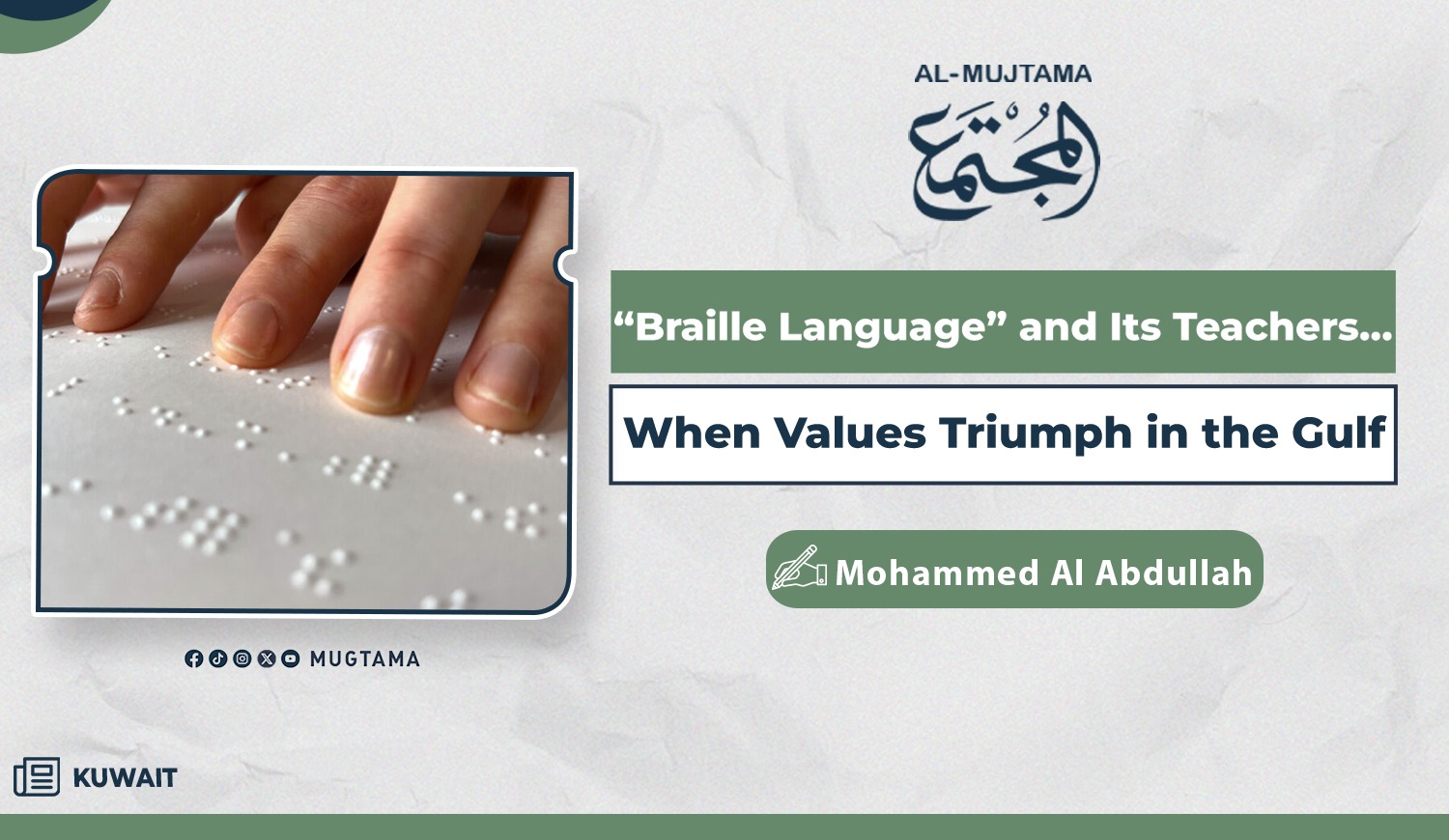
Every year on January 4, Kuwait and countries around the world
celebrate the World
Braille Day, named after Louis Braille, the inventor of the system that
enabled blind individuals to read, write, and pursue the world of knowledge.
A human being is defined by their actions; the more those
actions reflect the values of their society, the more they reveal the humanity
of the individual, the vitality of their heart, the light of their faith, the
presence of compassion, and their harmony with their community.
Coinciding with this occasion, a video circulated on the “X”
platform showing a Saudi teacher whose actions reflected a profound value—one
that showcased the beauty and spirit of Gulf societies and the compassion among
their people.
A Heroic Act by a Saudi Teacher
The protagonist of the video is the teacher of values before
anything else: Najla Mohammed Al‑Daqduqi, who embodied a living example of
human conscience when it acts according to principle rather than personal
comfort.
Al‑Daqduqi, the principal of Miqwa’ Girls Primary School, had
long awaited the chance to return to her family and work at a school near her
home after nine years of living away.
When the long‑awaited moment finally came, she was shocked to
learn that her transfer would leave her blind student, Muzn Al‑Sharari, alone.
She immediately reversed her decision and chose to stay with the student,
lighting her path with the compassion of her heart—despite her own children’s
need for her after years of absence, the death of her husband, and her daily
150‑kilometer commute to reach the school.
Challenges Facing Blind Students in Kuwait
Al‑Daqduqi’s video reopened discussions about the challenges
faced by blind students and the hardships they endure.
United Nations studies indicate that there are more than 35
million blind individuals in Arab countries, with numbers varying from one
nation to another—Sudan alone has around 225,000 blind individuals.
In the Gulf, statistics show that Saudi
Arabia has around 7,000 visually impaired students.
At Kuwait University, data revealed that most students with
disabilities suffer from physical impairments, totaling 125 students, followed
by 53 blind students across various colleges.
Visually impaired students in Kuwait face several obstacles
that hinder their ambitions and academic goals.
Years ago, Khaled Al‑Azmi, President of the Social
Sciences Society at Kuwait University, requested that the Dean of the
College of Social Sciences, Dr. Hamoud Al‑Qasha’an, exempt blind students from
scientific courses.
He explained that the request aimed to ease students’ burdens
and address their challenges through appropriate methods, stressing that
scientific subjects are extremely difficult for blind students and require
specialized adaptations that demand significant effort.
He also noted the real struggle blind students face when
required to study subjects such as statistics, physics, chemistry, and other
sciences—fields that rely heavily on visual components.
Meanwhile, Dr. Ali Al‑Yaqoub, Undersecretary of the Ministry
of Education, affirmed Kuwait’s strategic commitment to supporting this group,
emphasizing that the ministry has taken responsibility for meeting all special‑needs
requirements to maintain Kuwait’s leadership in education and innovation.
He revealed that special‑education schools have adopted the Braille
system for teaching blind students and implemented an inclusion policy to
ensure they enjoy full educational rights.
Officials and specialists in Kuwait highlighted that the Braille
system has contributed to:
- Facilitating
students’ participation in the learning process
- Using
available educational tools effectively
- Presenting
alphabetic and numeric symbols using six tactile dots
- Representing
every letter and number, including math and science symbols
- Establishing
Kuwait’s first computer‑based Braille printing press—Al‑Noor Press
Inspiring Examples in Kuwait
Despite the many challenges facing students in Kuwait,
there are inspiring success stories that deserve recognition—stories that
illuminate the path of perseverance and achievement.
One such example is Wael Al‑Araishi, a visually impaired
student who excelled in the 2025 high‑school exams with a score of 95%.
Al‑Araishi said: “I am a very ambitious person. I want to
leave my mark everywhere. How can someone work hard, attend school, and not
have access to knowledge?”
In a video circulated on YouTube, Al‑Araishi expressed his
love for the Arabic
language and his desire to study Islamic law and work as a mufti or a
Sharia judge. He openly stated that despite his ambition and excellence, he
faces a major obstacle: he believes he will not be appointed as a judge due to
his visual impairment.
Al‑Marzouq: A Passion for Media and Journalism
Another inspiring example is Kuwaiti student Nasser Al‑Marzouq,
whose visual impairment did not prevent him from studying media, continuing his
education, and living a normal life.
In press statements, he affirmed that his disability did not
limit his thinking or hinder his ambition to work in public relations. Instead,
it motivated him to give his best.
He added that this journey helped him discover new talents,
including a passion for journalism.
Regarding the challenges he faced, Al‑Marzouq said that before
entering university, discouraging voices questioned him: “Who will hire a blind
person? Why choose media?”
Al‑Marzouq ignored these voices entirely. In fact, the more
they tried to discourage him, the stronger his determination became.
He called on institutions to trust the abilities of blind individuals and people with disabilities in general, especially since modern technology now provides many assistive tools that make studying and working far more accessible.