









7 Etiquettes of Speech in Islam to Hold on To
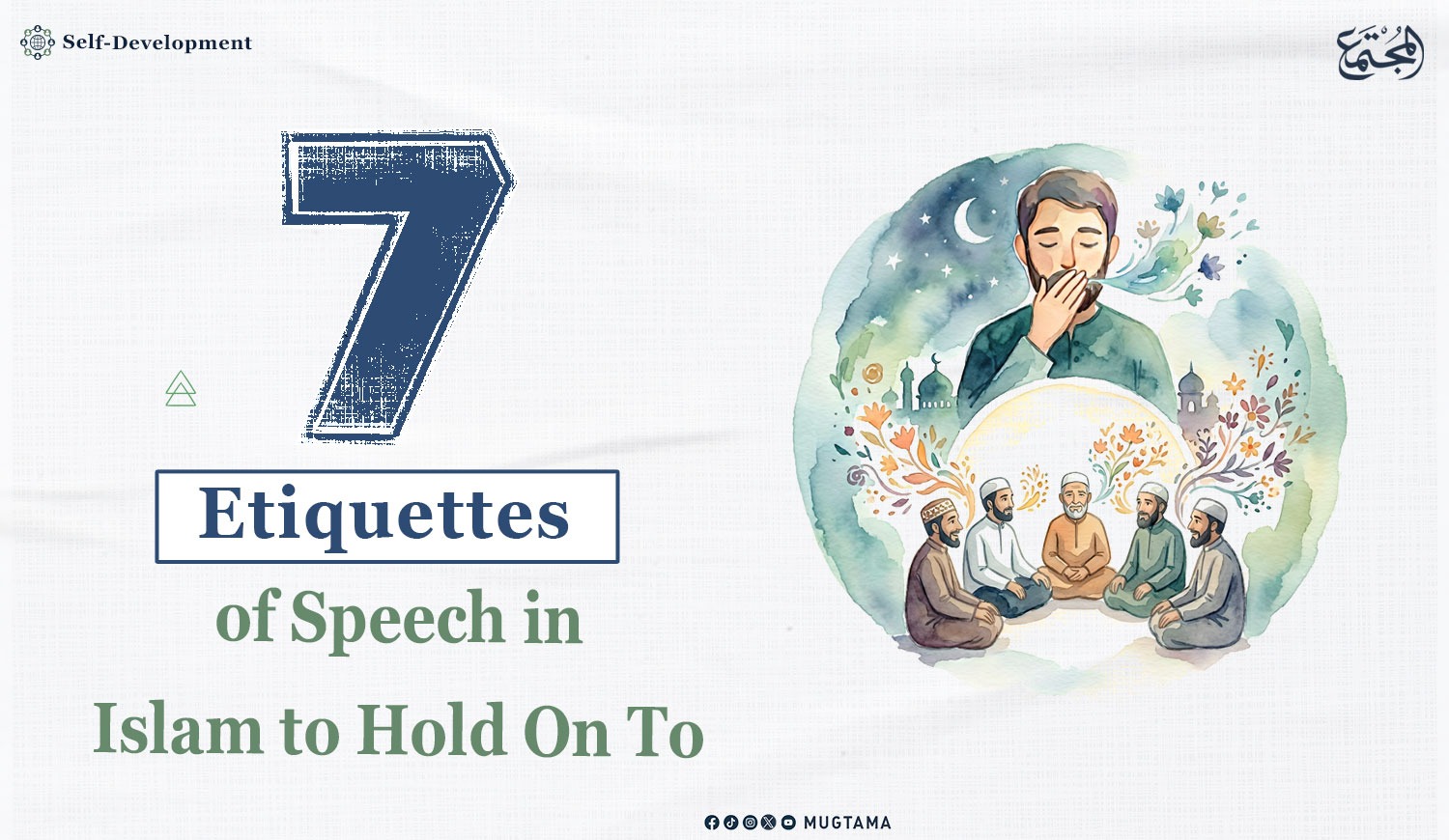
“Your tongue is
your horse; if you restrain it, it will protect you, and if you betray it, it
will betray you.” A well-known proverb that highlights the value of the tongue
and the words it produces—they can be a means of elevating a person, preserving
their dignity, honor, and identity, or they can become a curse and a cause of
downfall if left unchecked.
The Prophet
(peace be upon him) said: “The faith of a servant is not upright until his heart is
upright; and his heart is not upright until his tongue is upright” (Ahmad).
And Sahl ibn Sa`d narrated that the Prophet (peace be upon him) said: “Whoever
guarantees for me what is between his beard and his ankles, I guarantee for him
Paradise” (Al-Bukhari).
From this
perspective, a Muslim must guard their tongue and refine their speech,
transforming this blessing into a source of success in both this world and the
Hereafter—especially in an age where words hold increasing power through media,
communication, and social interaction, serving as a soft force in dialogue,
negotiation, persuasion, shaping awareness, and even winning battles.
The etiquettes
of speech are many, but here are seven of the most important, which ensure a
beautiful tongue, impactful words, and righteous action, by the will of Allah:
First: Monitoring the tongue—one must weigh their words before speaking and firmly
believe that their speech is observed by Allah.
“Not a word does a person utter without having a
˹vigilant˺ observer ready ˹to write it down˺.” (Qaf 50:18)
One must also
be certain that a single word may cast its speaker into Hellfire. The Prophet
(peace be upon him) said: “Indeed a man may utter a statement that he does not see
any harm in, but for which he will fall seventy autumns in the Fire” (At-Tirmidhi).
And when the Prophet (peace be upon him) said to Mu`adh, “Restrain this,”
pointing to his tongue, Mu`adh said, “O Prophet of Allah, will we be brought to account
for what we say?” He replied: “May your mother not found you, O Mu`adh! Are
people thrown onto their faces in Hell for anything other than the harvest of
their tongues?” (At-Tirmidhi).
Second: Avoid lying, backbiting, slander, violating people’s
honor, spreading rumors, and insulting others with offensive nicknames.
“O believers! Do not let some ˹men˺ ridicule others, they may be better
than them, nor let ˹some˺
women ridicule other women, they may be better than them. Do not defame one
another, nor call each other by offensive nicknames. How evil it is to act
rebelliously after having faith! And whoever does not repent, it is they who
are the ˹true˺ wrongdoers. O believers! Avoid
many suspicions, ˹for˺ indeed, some suspicions are sinful. And
do not spy, nor backbite one another. Would any of you like to eat the flesh of
their dead brother? You would despise that! And fear Allah. Surely Allah
is ˹the˺ Accepter of Repentance, Most Merciful.” (Al-Hujurat
49:11–12)
Third: Beware—truly beware—of allowing your tongue to become
a means of committing major sins through false testimony. In the two authentic
collections, the Prophet (peace be upon him) said: “Shall I inform you of the biggest
of the great sins?” He repeated it three times. They said, “Yes,
O Messenger of Allah.” He said: “To join partners in worship with Allah; to kill a
soul which Allah has forbidden to kill; and to be undutiful or unkind to one's
parents.” Then he sat up after reclining and said: “the false
witness,” and he kept repeating it until we wished he would
stop.
Fourth: Speak goodness and what benefits Muslims and people
in general, choosing kind and gentle words in dealing with others. The Prophet
(peace be upon him) said: “Let him who believes in Allah and the Last Day speak good,
or keep silent; and let him who believes in Allah and the Last Day be generous
to his neighbor; and let him who believes in Allah and the Last Day be generous
to his guest” (Al-Bukhari).
Fifth: One must avoid obscene, vulgar, and indecent
speech—even in jest, humor, or what is nowadays known as “mocking banter” among
football fans. `Abdullah ibn Mas`ud reported that the Messenger of Allah (peace
be upon him) said: “A true believer does not taunt or curse or abuse or talk
indecently” (At-Tirmidhi).
Sixth: Persist in the remembrance of Allah, and let the Book
of Allah and the Sunnah of His Prophet be present in one’s speech, occupying
the greatest share of the tongue—not songs, common sayings, or the modern trend
of quoting Western philosophers and leaders, when our great religion contains
treasures that illuminate the horizons of the world.
Seventh: Silence is salvation. It is a sign of wisdom and
composure, a trait of the righteous, and a characteristic of the servants of
the Most Merciful.
“The ˹true˺ servants of the Most Compassionate are
those who walk on the earth humbly, and when the foolish address them ˹improperly˺, they only respond with peace.” (Al-Furqan
25:63)
Read Also:
-
The Power of Dhikr Amidst Hardships
-
Allah's Remembrance in the Age of Social Media
-------------------------------------------------------------
