









Beyond Rituals
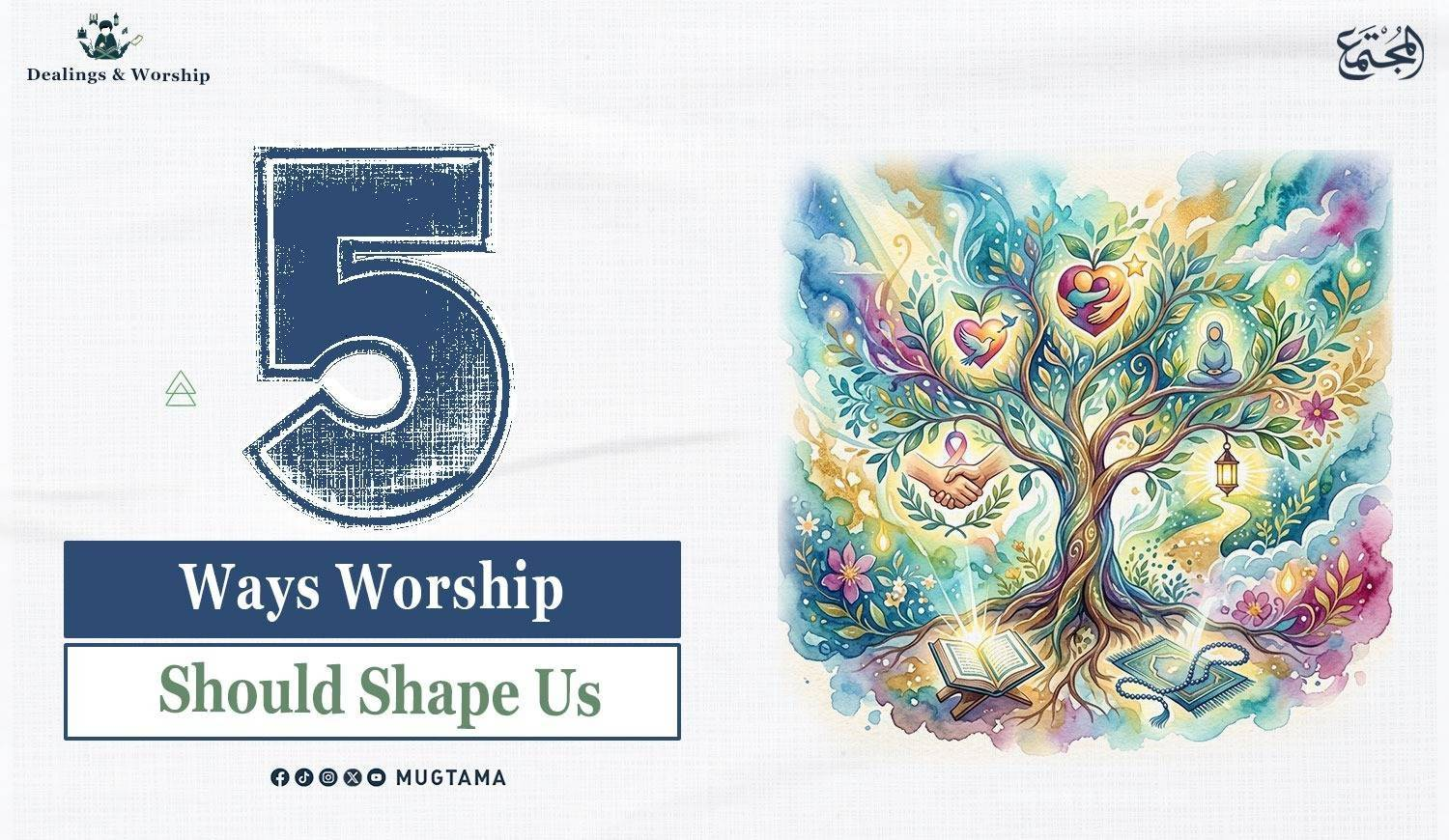
5 Ways Worship Should Shape Us
A person may spend long hours in
prayer, observe fasting and voluntary acts of worship, yet still treat others
harshly, lose their temper easily, wronging others or violating their rights.
This raises an important question: What is the value of worship if its effects
do not extend beyond outward rituals to the way we treat others?
In Islam, worship is not a
set of rituals disconnected from everyday life. It is an expression of devotion
to Allah, a means of purifying the soul, and a way of cultivating an awareness
of His presence in both private and public life. Allah says in the Quran: {Indeed, ˹genuine˺ prayer should deter ˹one˺ from indecency and wickedness.} [Al-`Ankabut 29:45] Examining
how worship shapes our conduct is therefore an important part of striving for
righteousness.
How Does Worship Shape Our Character?
1.
Controlling Anger: Can You Restrain Yourself During Conflict?
The struggle to discipline the soul becomes most apparent when we are provoked, contradicted or
faced with something that threatens our interests. Does anger lead us to lash out
and hurt others, or does our awareness of Allah bring us back to fairness and
restraint? Can we accept an apology and acknowledge when we are wrong, or do we
use other’s mistakes as an excuse for revenge?
The goal is not to eliminate
anger, a natural human emotion, but to prevent it from leading to injustice. A
person who stands before Allah in prayer should be reminded of His limits and
encouraged to refrain from harming others. Reverence in prayer should not
coexist with harshness towards Allah’s creation.
2.
Honoring Others’ Rights: What Happens When Your Interests Are at
Stake?
A person may be diligent in
voluntary worship yet careless about repaying a debt, paying a worker fairly or
treating someone in need with justice. This is a serious form of heedlessness,
because fulfilling religious duties and performing additional acts of worship
do not erase the rights owed to other people.
The Prophet Muhammad (peace and
blessings be upon him) said: “Do you know who is
poor?” They (the Companions of the Holy Prophet) said: “A poor man amongst us
is one who has neither dirham with him nor wealth.” He (the Holy Prophet) said:
“The poor of my Umma would be he who would come on the Day of Resurrection with
prayers and fasts and Zakat but (he would find himself bankrupt on that day as
he would have exhausted his funds of virtues) since he hurled abuses upon
others, brought calumny against others and unlawfully consumed the wealth of
others and shed the blood of others and beat others, and his virtues would be
credited to the account of one (who suffered at his hand). And if his good
deeds fall short to clear the account, then his sins would be entered in (his
account) and he would be thrown in the Hell-Fire.” (Sahih Muslim,
2581)
One of the fruits of sincere
worship, therefore, is greater restraint from wrongdoing, greater faithfulness
to trusts and greater respect for people’s rights. A Muslim should not take
comfort in an abundance of good deeds while neglecting others’ rights.
3.
Guarding the Tongue: Does Fasting Lead to God-Consciousness?
Fasting was not prescribed merely
to teach us to endure hunger and thirst. Allah says, {So
that you may become mindful ˹of Him˺.} [Al-Baqarah 2:183] This mindfulness requires Muslims
to guard
their tongues against lying, backbiting and slander, and to
resist the temptation to engage in vulgar or hostile speech.
The Prophet Muhammad (peace and
blessings be upon him) said: “Whoever does not
give up forged speech and evil actions, Allah is not in need of his leaving his
food and drink (i.e. Allah will not accept his fasting.).” (Sahih al-Bukhari, 1903)
Fasting calls for more than abstaining
from what is ordinarily permissible. It should also help a person resist what
Allah has forbidden. One sign that worship is shaping character is the ability
to control one’s speech, refrain from harming others and discipline the soul in
pursuit of Allah’s pleasure.
4.
Showing Mercy and Humility: How Do You Treat Those Who Cannot
Benefit You?
Purifying the soul includes showing kindness to the vulnerable, preserving the dignity of workers and
servants, and refusing to look down on others because of differences in wealth,
status or knowledge. A believer should not measure people by what they can
offer in return, but should treat them with justice and goodness, mindful of
their rights before Allah.
The Quran condemns neglect of
orphans and the failure to encourage the feeding of the poor: {Have you seen the one who denies the ˹final˺ Judgment? That is the one who repulses the orphan, and does not
encourage the feeding of the poor.} [Al-Ma`un 107:1–3] This
reminds us that righteousness cannot be separated from compassion towards
others, and that worship should never become a source of arrogance or cruelty.
5.
Sincerity and Trustworthiness: Who Are You When No One Is
Watching?
The sincerity of a person’s faith
is tested when they are alone and have an opportunity to betray a trust without
anyone finding out. Do they protect what has been entrusted to them? Do they
carry out their work properly when supervision is absent? Do they honor their
commitments when there is no fear of criticism or punishment?
Remembering that Allah knows what
is hidden is a powerful source of sincerity and steadfastness. Worship is not
performed to win people’s praise, but to seek the pleasure of Allah. The
stronger this awareness becomes in the heart, the more likely it is to be
reflected in honesty, trustworthiness and keeping one’s promises.
Is Worship a Private Matter?
The effects of worship should not
stop at a person’s relationship with Allah. They should also be reflected in
how that person treats family members, colleagues and the wider community. The
Prophet Muhammad (peace and blessings be upon him) said: “The most perfect man in his faith among the believers is
the one whose behaviour is most excellent.”
(Jami` At-Tirmidhi, 1162)
This hadith highlights good character as a mark of complete faith and reminds Muslims that their
relationship with Allah should leave a mark on their dealings with His
creation. This does not mean that every person who falls short in character
lacks faith, or that every moral failing renders their worship invalid. Rather,
believers are called to keep striving against their weaknesses, seek Allah’s
mercy and correct their shortcomings.
One of the most important ways to
hold ourselves accountable is to examine what worship is producing in our hearts
and actions. Has it made us more humble or more arrogant? More careful about
other people’s rights or more willing to violate them? More compassionate or
more hard-hearted?
This is not a claim that we can
judge whether Allah has accepted someone’s worship. It is a reminder that
believers must continue striving to purify their souls, improve their conduct
and ensure that their worship helps them live with righteousness, integrity and
good character.
