







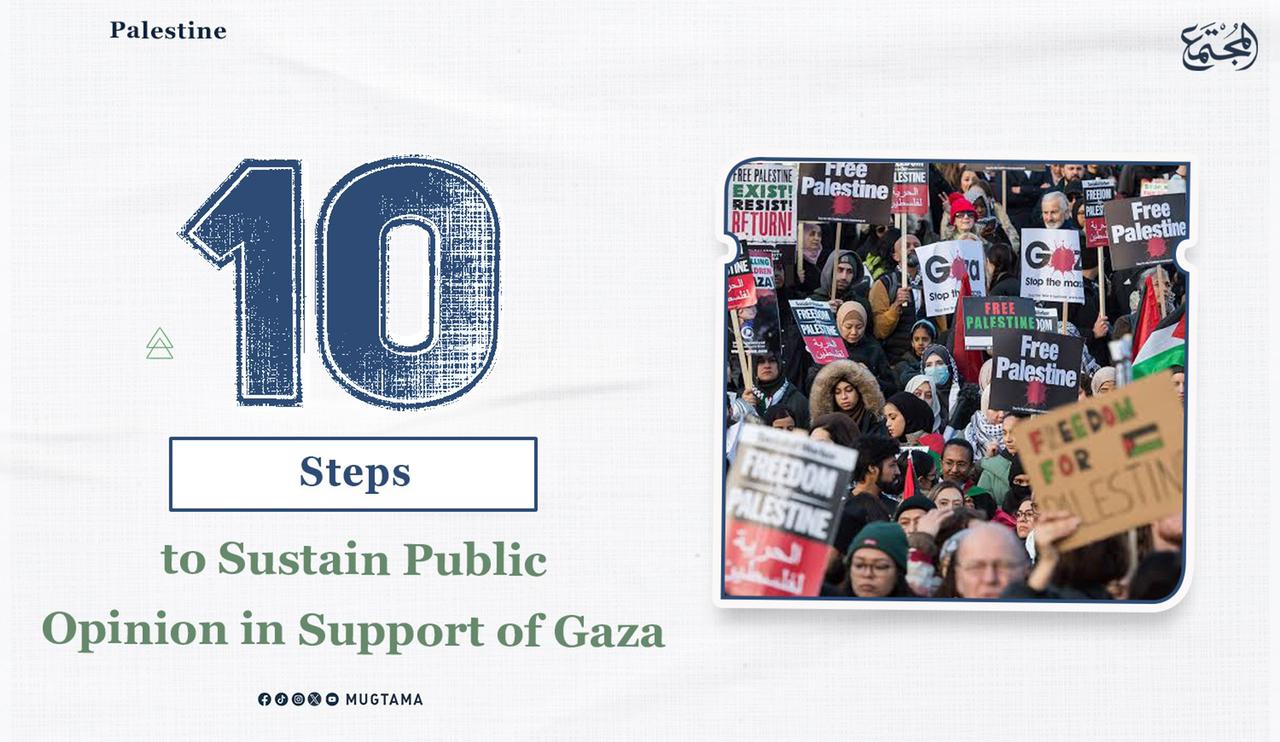
10 Steps to Sustain Public Opinion in Support of Gaza
In a world where events are rapidly
unfolding and crises pile up one after another, maintaining Gaza’s presence in
the global consciousness becomes a complex task that requires careful planning
and a long-term strategy.
The massacres and violations
documented by the UN and human rights bodies such as the United Nations, the Human
Rights Council, and Human Rights Watch have provided a vast body of material
for public opinion. However, keeping this awareness alive and continuously
renewed depends on how this content is managed, directed, and transformed into
an ongoing narrative that does not fade
Hence, the need emerges to build a
comprehensive strategy for sustaining public opinion one that is based on a set
of interconnected steps which together form an integrated and cohesive
framework.
1. Transforming the narrative
into an ongoing human story:
Sustainability begins by transforming
the Gaza narrative from mere numbers into vivid human stories. According to
studies by the Reuters Institute for the Study of Journalism, individual
stories are more influential and more widely shared than abstract data,
increasing emotional engagement by sixfold compared to traditional news
content.
2. Continuous and Renewed Media
Production:
Alongside storytelling, continuous
media production takes on added importance. According to the guidelines of
UNESCO for conflict reporting, gradual and sustained coverage protects
audiences from disengagement and fills the vacuum that may otherwise be
exploited by the “Israeli” narrative or other counter-discourses.
Short videos, daily summaries,
infographics, and live broadcasts form windows that keep Gaza present in the
global digital consciousness.
3. Linking Gaza to Universal
Values:
However, sustaining public opinion
cannot rely on emotions alone; it requires connecting the cause to universal
human values, such as civilians’ right to life, the protection of children, and
the rejection of collective punishment.
Reports by Human Rights Watch and
Amnesty International, alongside reports from UNRWA and the International
Committee of the Red Cross, have confirmed the ongoing violations against
civilians in Gaza. This provides advocacy campaigns with a solid human-rights
foundation, allowing their messaging to transcend politics and reach a wide
global audience.
4. Using Simple and Engaging
Language:
Since audiences experience cognitive
fatigue due to the constant flow of news, simplifying language becomes a
crucial element in maintaining engagement.
Reports from the Peterson Institute for
Mass Communication indicate that short,
clear sentences can increase reach by nearly 40%. Therefore, it is preferable
to deliver messages in a direct, emotional, and easily quotable language, making
the content widely shareable.
5. Activating Public Opinion
Ambassadors:
Another influential factor is
activating “public opinion ambassadors” such as influencers, journalists,
academics, and artists. Media studies show that audiences engage more with individuals
than institutions, and reach increases fivefold when influencers participate in
advocacy campaigns. They serve as bridges to community segments that
traditional campaigns often fail to reach.
6. Working Through Focused
Waves:
The framework is completed by adopting
a focused-wave model, or clustered campaigns, where each week is dedicated to a
specific theme such as children, the healthcare sector, or targeting the press.
This approach, extensively documented by the Committee to Protect Journalists
(CPJ), helps renew momentum and connect audiences to a sequence of events,
rather than relying solely on immediate emotional reactions.
7. Producing Content in
Multiple Languages:
Translation also plays a pivotal role.
According to the 2024 Global Digital Report, most of the global audience does
not follow Arabic content, making it strategically necessary to publish content
in multiple languages English, Spanish, Turkish, and French to expand the
support base and reduce the Western media’s monopoly over the narrative.
8. Forming Alliances with Civil
Society Organizations:
Sustainability also requires
partnerships with civil society organizations such as unions, student
associations, and human rights groups. International human rights networks have
confirmed these entities’ ability to translate digital solidarity into
political pressure, whether at the level of parliaments, universities, or
municipal councils.
9. Focusing on Evidence and
Investigations:
Documentation remains an indispensable
pillar. Reports from the United Nations, Human Rights Watch, B’Tselem, and
UNRWA provide verified material that supports the Palestinian narrative,
granting advocacy campaigns high credibility and protection against skepticism.
Every image, testimony, or official report reinforces global awareness that the
cause is not merely a story but a verified reality.
10.
Turning Digital Engagement into Real-World
Action:
Finally, sustainable awareness is
achieved only when digital engagement is transformed into real-world action.
According to studies by mass
campaigning organizations such as MoveOn and Avaaz, the most impactful
campaigns are those that link online dissemination with practical steps such as
protests, parliamentary pressure, economic boycotts, or student events. Every
on-the-ground activity recharges public opinion and gives it a reason to
persist.
With this integrated framework human
storytelling, continuous media coverage, simple language, documentation,
translation, focused campaigns, civil partnerships, and public opinion
ambassadors a renewed global public opinion can be built that keeps Gaza
present in the human conscience and transforms solidarity from a fleeting
moment into a rising, enduring movement.
You may also like :
Five serious repercussions of the UN Security Council’s decision on Gaza
Out of the rubble, cities are reborn… Lessons from history for Gaza.
How do you participate in the reconstruction of Gaza?
Gaza’s Reconstruction: The New Jihad of Rebirth and Renewal